Sinbosen WL12 Dual 12-inch Line Array Speaker – All-New Upgrade
- Share
- Issue Time
- Nov 27,2026
Summary
The WL12 dual 12-inch line array speaker has undergone a core component upgrade. This enhancement focuses on the mid-high frequency section: the mid-range driver has been upgraded to a 6.5-inch neodymium-magnet unit, and the high-frequency driver has been upgraded to a 44mm (1.75-inch) voice coil unit.
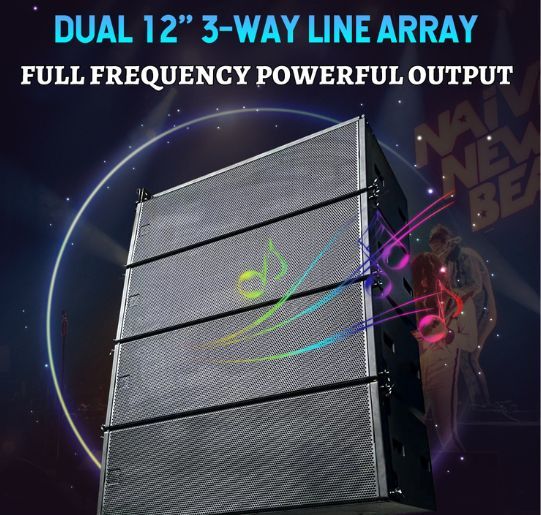
Sinbosen has recently upgraded the core components of its WL12 dual 12-inch line array speaker: the mid-frequency section now features a 6.5-inch neodymium-magnet midrange driver, while the high-frequency section has been upgraded to a 44mm (1.75-inch) neodymium-magnet compression driver. By retaining the signature fully horn-loaded architecture and enclosure design of the WL12, this upgrade significantly enhances mid-to-high frequency performance, delivering a more refined auditory experience for large-scale live events and fixed installations.
Upgrade 1: 6.5″ ferrite-magnet midrange driver → neodymium-magnet midrange driver
The mid-frequency channel serves as the "soul" of the line array system. In the WL12, two 6.5-inch cone drivers handle the 300Hz–4kHz range—covering the fundamental frequencies of human voices and most musical instruments. By employing a horn-loaded design with a constant-directivity waveguide, this configuration achieves higher efficiency and more precise directional control compared to conventional direct-radiating mid-frequency designs. In this iteration, the magnetic circuit has been upgraded from ferrite to neodymium (NdFeB), delivering improvements across four key dimensions:
① Enhanced Sensitivity and Output Efficiency: Neodymium magnets possess a maximum energy product (BHmax) several times higher than that of ferrite. With the same power input, they exert greater force on the voice coil, resulting in a higher maximum sound pressure level (SPL) in the midrange and a more robust, energetic sound field.
② Superior Thermal Stability: Ferrite magnets suffer from flux attenuation at high temperatures (due to their temperature coefficient), which can cause the midrange to sound "softer" or less defined during prolonged, high-power operation. Neodymium-based magnetic circuits, combined with a more compact flux path, offer better thermal stability—ensuring that vocal density remains consistent even during long-duration, full-load performances.
③ Faster Transient Response and Sharper Vocal Presence: Higher magnetic flux density allows the voice coil to react with greater force and precision. This results in clearer articulation—capturing subtle details like sibilance, breaths, and enunciation—while providing a more focused "positional" sense for the vocalist, along with significantly improved layering and separation in the midrange.
④ Reduced Weight and Optimized Power-to-Weight Ratio: Neodymium magnets are much smaller than ferrite magnets of equivalent performance. This allows for a design that simultaneously boosts performance while reducing weight—a welcome enhancement for a system weighing 64kg, making it even more practical for touring applications.
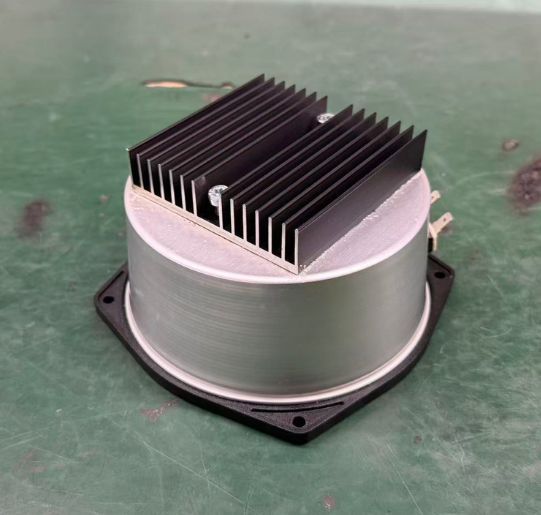
Neodymium-magnet midrange speaker
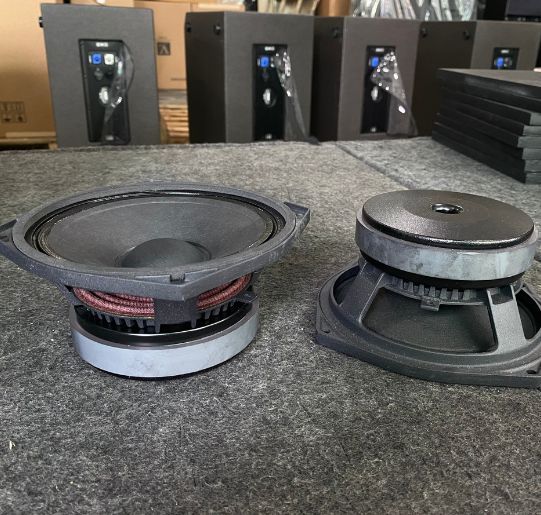
Ferrite Midrange Speaker
Upgrade 2: 38mm (1.5-inch) voice coil tweeter → 44mm (1.75-inch) voice coil tweeter
The high-frequency section of the WL12 consists of three compression drivers, each coupled to an individual horn, creating a true 90° horizontal constant-directivity pattern. The horn exits feature a vane-style separator structure, which effectively manages the spacing between the acoustic centers of the mid-high frequency horns, thereby minimizing interference distortion at high sound pressure levels. In this iteration, the voice coil has been upgraded from 38mm to a larger 44mm neodymium-magnet driver—a significant, "class-leaping" enhancement in high-frequency performance.
① Significantly increased power handling. The voice coil diameter has been enlarged by approximately 16%, with a corresponding increase in both winding length and heat dissipation surface area. This allows for more rapid thermal dissipation, providing greater headroom for both long-term and short-term peak power.
② Reduced thermal compression for greater stability during high-dynamic performance. The phenomenon often encountered during live performances—where high frequencies become progressively duller—is caused by thermal compression. The 44mm (1.75-inch) voice coil offers a higher thermal capacity, ensuring minimal frequency response drift even during prolonged, high-dynamic, high-frequency output, thereby maintaining consistent high-frequency brightness from start to finish.
③ Lower distortion and enhanced detail. The larger voice coil applies force more uniformly across the diaphragm, reducing breakup modes. This leads to a significant decrease in harmonic and intermodulation distortion above 4kHz—preserving intricate details such as the metallic shimmer of cymbals, the rich, resonant texture of string instruments, and the subtle breathiness in vocal performances.
④ Extended high-frequency range and increased throw. The 44mm driver features superior coupling between the diaphragm and the voice coil, resulting in an extended high-frequency limit and greater far-field energy. When paired with a dedicated horn waveguide, the system maintains exceptional clarity and penetration over distances of 40–80 meters or more—meeting the rigorous long-throw coverage requirements of stadiums and large-scale outdoor music festivals.
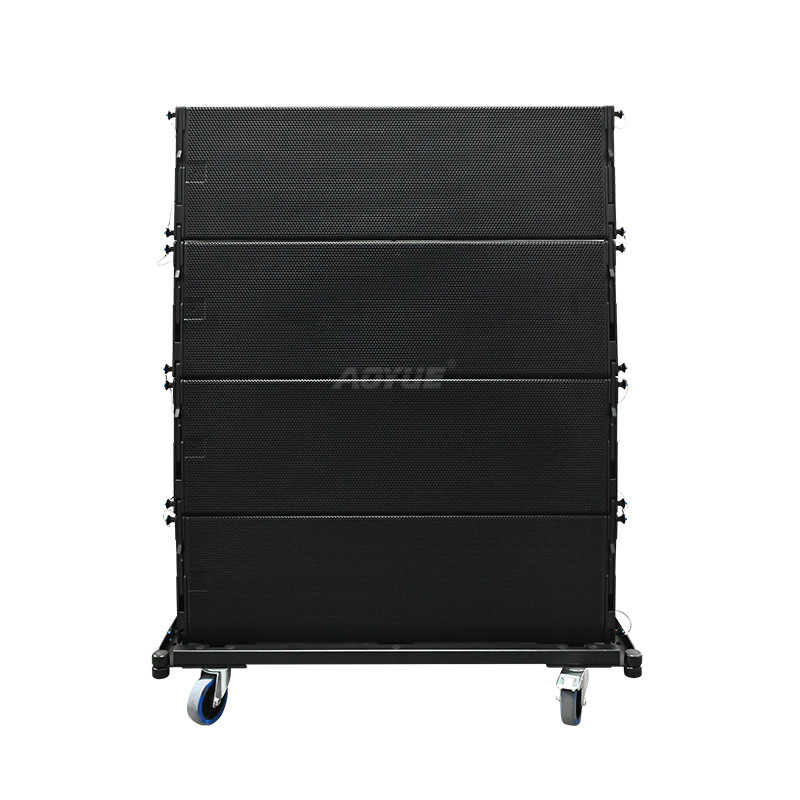
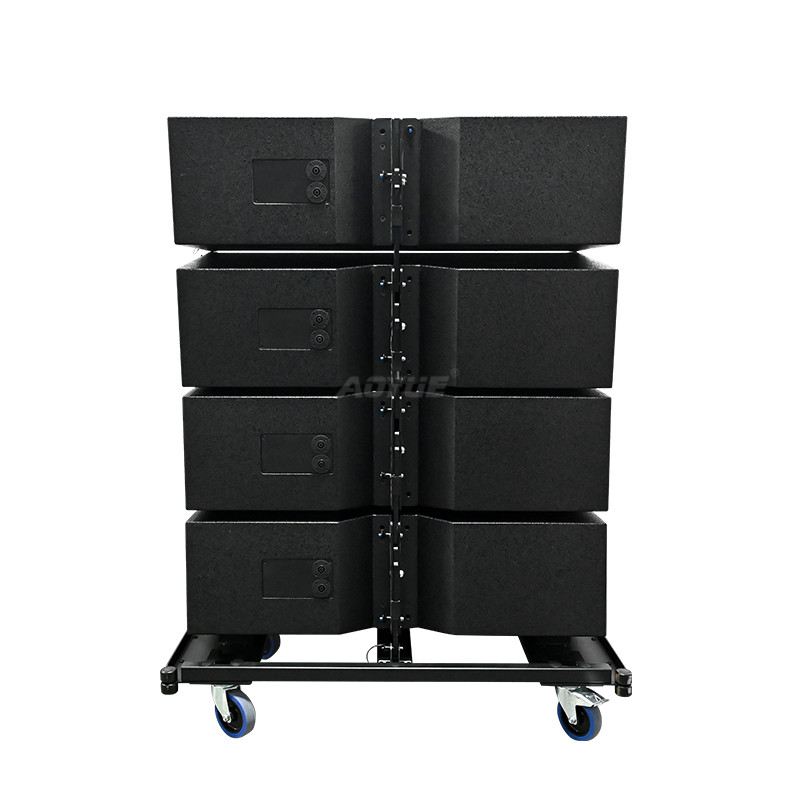
Advantages of the WL12 Line Array Speaker
1. Three-way, dual-amplified design with precise crossover
The system employs a dual-amplified architecture featuring an active crossover at 320 Hz combined with an internal passive crossover at 4 kHz. The low-frequency and full-range (mid-high) sections are each driven by dedicated amplifier channels with independent DSP headroom. This configuration allows for precise phase control in the crossover overlap region, effectively eliminating the "frequency contention" often found in the mid-range of two-way systems, while providing greater flexibility for system tuning.
2. Dual 12″ Neodymium Woofers: Hybrid Horn/Bass-Reflex Loading
The low-frequency section utilizes two 12-inch, long-excursion neodymium drivers (with 75mm voice coils) housed in a hybrid enclosure that combines horn loading with a bass-reflex (ported) design. The horn provides powerful projection and impact, while the bass-reflex chamber extends the low-frequency reach and adds weight to the sound. Compared to conventional direct-radiating designs, this configuration increases acoustic efficiency by approximately 4dB, resulting in lower power consumption for the same sound pressure level (SPL). Furthermore, the low-frequency directional control extends effectively down to about 150Hz, significantly reducing the buildup of unwanted acoustic energy on stage and against side walls—a key distinction between professional large-scale line arrays and standard loudspeakers.
3. Full-Band Horn Loading: Delivering Every Bit of Energy to the Audience
The WL12 is engineered for maximum efficiency through full-band horn loading: the low, mid, and high-frequency bands are all shaped and projected via horns. Rather than allowing sound waves to disperse chaotically in all directions, the horns focus the acoustic energy into a controlled, concentrated beam. This design achieves a maximum peak SPL of 139dB (LF), 140dB (MF), and 145dB (HF) (measured at 1m with a 6dB crest factor), with a frequency response of 52Hz–18kHz (±3dB). Despite its dual 12-inch configuration, it delivers output capabilities comparable to systems with much larger drivers.
4. 90° × 7.5° Constant Directivity: Consistent Tonality Throughout the Venue
With a 90° horizontal (-6dB) constant-directivity pattern and a 7.5° vertical dispersion angle, the system ensures that the frequency response remains highly consistent—whether on-axis or off-axis. This means that audience members, regardless of whether they are seated in the center or on the sides, in the front rows or the back, experience virtually the same tonal quality. This characteristic is essential for achieving uniform coverage in large venues and significantly eases the burden on sound engineers, who otherwise struggle to balance sound quality across different areas of a space.
5. Tour-Grade Craftsmanship: The Aesthetics of a 64kg Power-to-Weight Ratio
The enclosure is constructed from multi-ply birch plywood and finished with a durable, textured black coating. A perforated steel grille protects the drivers, while integrated side handles allow for easy, one-person handling. Weighing in at just 64kg, this unit is remarkably lightweight for a dual 12-inch, three-way, fully horn-loaded line array—a significant advantage for touring teams that move frequently, as every kilogram saved translates directly into reduced transport costs and faster setup times.
WL12 Application Scenarios
Large-scale outdoor music festivals / concerts: The long-throw capability of the 44mm-voice-coil high-frequency driver, combined with the vocal density provided by the neodymium-magnet mid-frequency driver, ensures that even the audience in the very last row can hear every single word of the lyrics clearly.
Stadiums / Arenas: Featuring a fully horn-loaded architecture and 90° constant directivity, the system delivers uniform coverage over long distances—effortlessly handling large-scale arrays of up to 24 units.
Theaters / Auditoriums / Multipurpose Halls (Fixed Installations): Horn-loaded mid-frequency drivers deliver precise speech intelligibility, while the neodymium-magnet mid-frequency units offer excellent long-term thermal stability, ensuring a low-maintenance, hassle-free experience.
Rental and Touring Companies: With the enclosure design and rigging system remaining unchanged, the system is fully compatible with existing accessories, transport dollies, and amplifier DSP presets—allowing for an upgrade with zero learning curve.